
Your AI Agents
Are Overqualified.
And You're Paying for It.
CIOs at leading enterprises are overspending on AI agents they can't fully justify or control, and how to fix it.
At Aible, we work with CIOs across major industries, and they’re all living with the same contradiction. Demand for AI is going vertical. Their IT budgets remain horizontal.
The challenge comes down to this: most enterprise AI agents are overqualified for the jobs they’re given. They are autonomous agents running on frontier models built to do everything from writing code to drafting a novel to planning a vacation. But in the enterprise, they’re asked to do focused, specialized work, like processing an order or analyzing last week’s sales. Every time the agent runs, you pay for everything the model can do. Aible’s Minimum Viable Agency (MVA) agents receive only enough agency to do their specific task - nothing more. In our recent benchmarks with NVIDIA, the share of AI spend that went to the actual task, as opposed to the potential to do many different types of tasks, was less than 1%.
Gartner expects over 40% of agentic AI projects to be canceled by the end of 2027, citing escalating costs, unclear business value and inadequate risk controls. Those are the three most common problems we hear from the CIOs we speak to every day.
-
The first is the budget. Many companies tried to fund AI by cutting headcount and moving the savings into AI spend. It hasn't paid off, because most of that money goes to general-purpose capability the task never actually uses. Forrester expects half of AI-attributed layoffs to be quietly reversed.
-
The second is value. Ask most organizations what a given AI project is worth and you'll get an industry statistic or an anecdote, not a measured number the CFO will sign off on.
-
The third is risk. An autonomous agent with broad access to tools, data and systems is a security exposure, and the CIO owns that risk. Even Satya Nadella, Microsoft’s CEO, is now calling autonomous agents ‘insider risks.’
We believe that every AI agent should earn its way into production. It takes three steps: build it, profile it, and securely scale it.
Build it
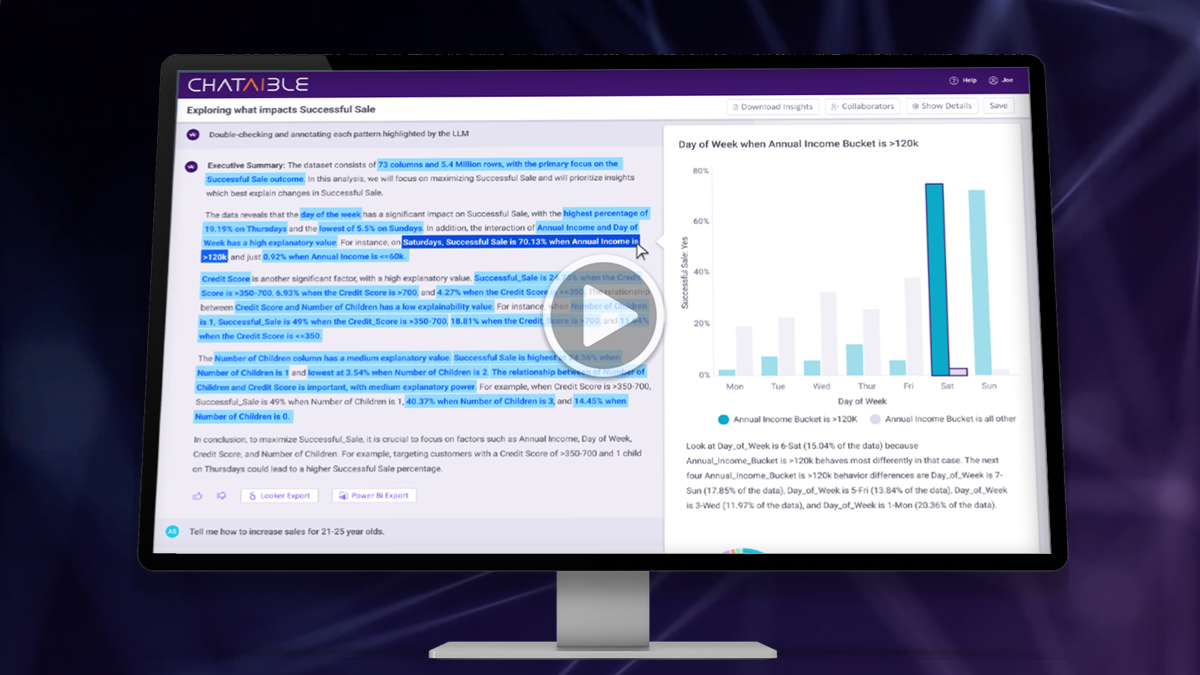
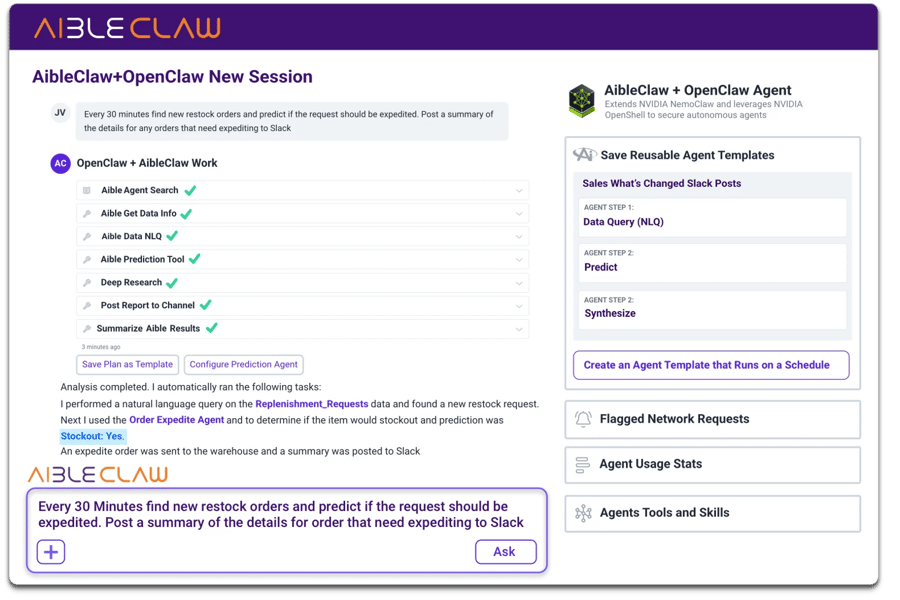
Demand for AI won’t wait for IT to build agents to perform specialized business tasks. So let your business teams explore what’s possible themselves. They can start by simply describing the task in plain language. For example: “Process incoming customer orders, based on the order details, review the shop inventory and the delivery promise date guidelines to determine the promise date. Email the customer a response with a specific delivery promise date.” AibleClaw prototypes the agent from that description, with no technical background required. About 80% of the time it works on the first try. The rest of the time it gets there with a few hints and user feedback.
For the CIO, what matters is that this experimentation is safe. Prototypes run in a secure sandbox disconnected from enterprise systems, so teams can try and test ideas freely without putting enterprise systems at risk. The cost is also capped because the prototypes use local models running on RTX laptops, RTX/DGX desktop supercomputers, DGX deskside supercomputers, or dedicated servers. There are no per token or per agent or per user costs.
Profile it
A CIO’s confidence to scale an agent rests on two numbers: the economic impact of the agent to the business and what it costs to run.
The first number comes from what the agent delivers each time it succeeds, the impact to the business when it fails, how often it runs, and how many people use it. You also need to test the agent and measure its actual success rate. The result is a total impact number that proves each agent’s Business Impact. Annual Business Impact = (Benefit of Success * Success Rate - Cost of Failure * Failure Rate) * How often the agent runs per user in a year * number of users.
The second number is the agent’s running cost, including the infrastructure it needs and the licensing. This should be compared to what the same agent task would cost on alternatives such as Anthropic or OpenAI. In benchmarks conducted with NVIDIA, a specialized Aible agent analyzed sales performance at 4,712 times lower token cost than a Claude autonomous agent running Opus 5.5. On a far more complex order-processing task, it was still 1,401 times lower. In both cases, a $100,000 token bill would shrink to less than $100. The savings come from two places: the specialized agent uses far fewer tokens, and it runs on a smaller open model that costs much less per token. That difference in costs is what solves the CIO’s budget gap problem, without having to cut headcount to solve it.
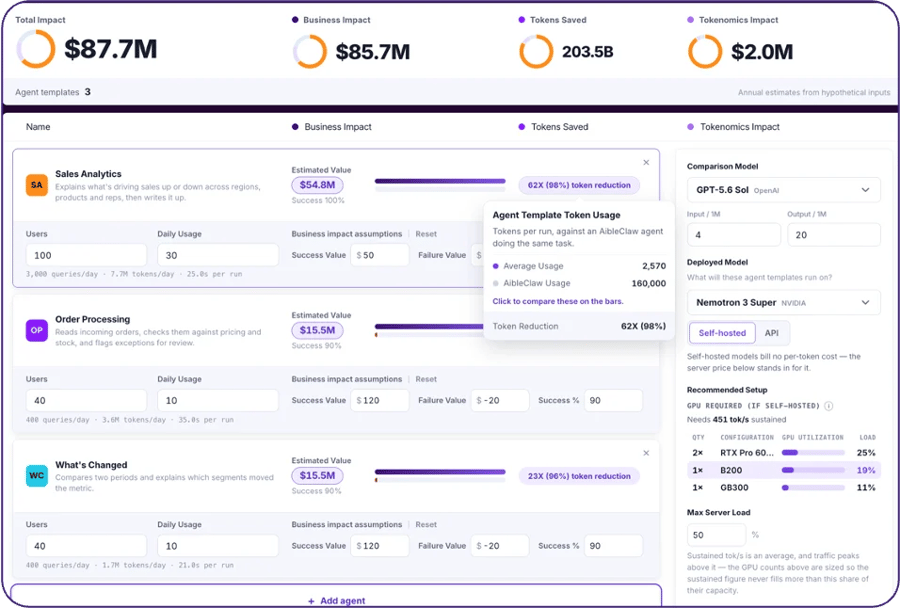
The ROI comes from the difference in the Annual Business Impact and the Operating Cost. Aible makes it easy to prove the expected Annual Business Impact and the expected operating cost via bottoms up testing. Aible MVA agents also reduce the Operating Cost massively compared to autonomous agents using frontier models because all of the spend is going towards the actual work the MVA agent is doing, not the ability of the autonomous agent to also do a lot of tasks it is not being asked to perform.
Securely scale it
Rogue agents are a risk every CIO ends up owning, and it isn’t hypothetical. McKinsey reports that 80% of organizations have already encountered risky behavior from AI agents, including unauthorized access to systems. With Aible, you get a specialist agent built on what we call Minimum Viable Agency (MVA), with only enough agency to do its specific job, and nothing more. Its plan, tools and memory access are all locked down, so it can’t go rogue. Essentially the same process that saves you significant amounts of money by focusing the agent on the specific task also reduces the vectors of attack and the blast radius from an agent going rogue or being co-opted by a rogue agent.
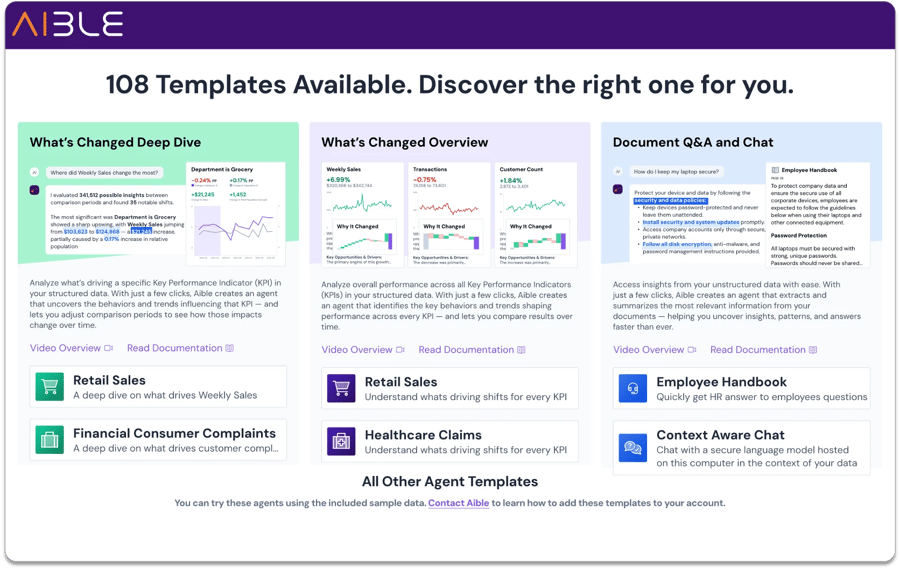
You promote the exact MVAs that you profiled in AibleClaw into Aible with one click, and business users run the MVA agents now inside a system built for control and cost containment. If the agent used sample data from your Salesforce in the AibleClaw prototype environment for example, you just point it at the corresponding Salesforce MCP server in the Aible environment. Only safe, human reviewable, JSON files defining agent templates move between the AibleClaw prototype environment and the Aible production environment. Templates execute consistently at scale, and they run wherever you need them: a Dell server, HPE Private Cloud AI, Cisco edge infrastructure, your preferred cloud or a neocloud. It all just works. For the CIO, that means scaling AI without scaling the risk.
AI has to earn its place in the enterprise, and the CIO is the one who holds it to that standard. Every agent should be able to show what it’s worth, what it costs, and why it needs the access it has. If it can’t, it doesn’t belong in production.
CIOs who want to put this to the test can contact us here.


