

How NVIDIA Nemotron 3.5 Super VL enables Aible Minimum Viable Agency
The risk of rogue AI agents is a key concern as AI moves from experimentation to production. At Aible, we believe that shift calls for approaches designed to work at scale. For example, in manufacturing, organizations first build a prototype, then observe the prototype, rethink its component parts to optimize for cost and performance at scale, then produce the same product at industrial scale, reliably, at far lower cost. We need such “production-engineering focus” in AI today
The biggest problem with rogue agents is that they manage to co-opt unrelated autonomous agents to assist with their task. Thus, every enterprise autonomous agent needs to be carefully secured and monitored. Agent autonomy - or agency - increases as model sizes, token limits, prompt size, memory size, and tools access increases. Aible only gives each agent enough agency to do their specific job. No more. This is Minimum Viable Agency (MVA).
Autonomous agents are like skilled artisans that can make anything, but require time and money while the quality varies considerably. Aible automatically observes and then translates such autonomous agents into locked-down MVA agents that industrialize the process to deliver business impact consistently at significantly lower cost and typically higher accuracy. The autonomous agents remain silicon-bound (potentially physically air-gapped), token-capped, and time-capped during the observation period and only the MVA agents ever get access to enterprise systems at scale.
Aible’s MVA agents avoid the risk of being co-opted by rogue agents or going rogue themselves while massively decreasing their cost - because their agency is completely locked down to the use case. By reducing the degrees of freedom of the agents while maintaining their effectiveness for the assigned tasks, Aible also reduces the vectors of attacks as well as the potential impact (blast radius) of attacks.
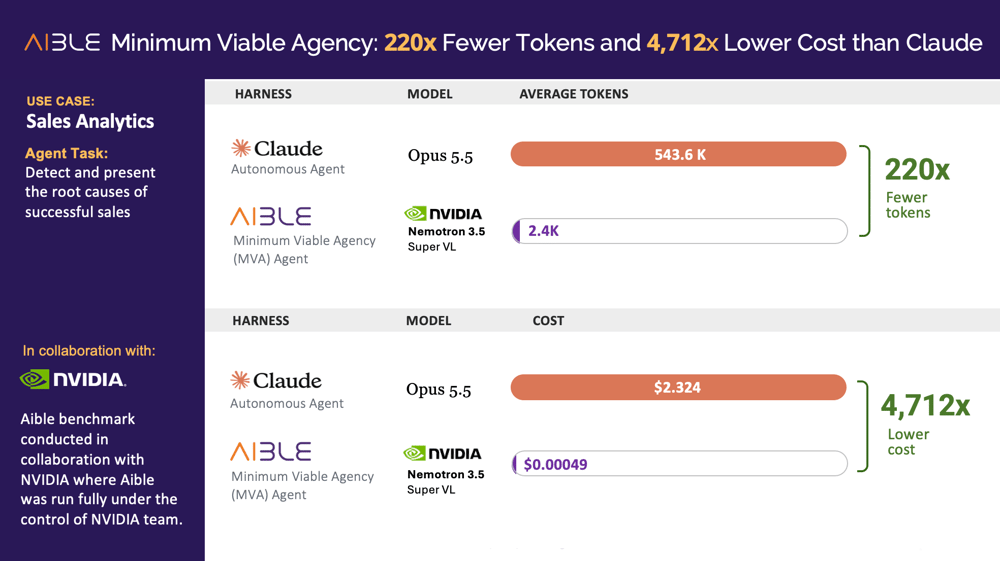
The analysis above was conducted in collaboration with NVIDIA where Aible was run fully under the control of the NVIDIA team and the Aible token numbers below were collected by them. For the Nemotron 3.5 Super VL cost numbers we used the costs for Nemotron 3 Super as reported by OpenRouter as a proxy. Once we test the Nemotron 3.5 Super VL NIM we fully expect its cost to be lower than Nemotron 3 Super due to multiple optimizations in the new model. This will make the cost multiple reported below even more attractive. The Claude numbers were collected by Aible as reported by OpenRouter and do not consider cache hits during the benchmarking process.
As expected, the degree of tokenomics impact from MVA would vary depending on the use case. The token reduction was highest for analytics use cases where Aible has specialized tools that deterministically look at millions of variable combinations to guide the analytics path. The same deterministic tools are also used to double-check the output and confirm that the generative AI did not hallucinate, which drives up accuracy. In each of the cases, the accuracy of the MVA was at least comparable to that of the corresponding frontier autonomous agent.The token reduction was lower for cases like complex process automation.
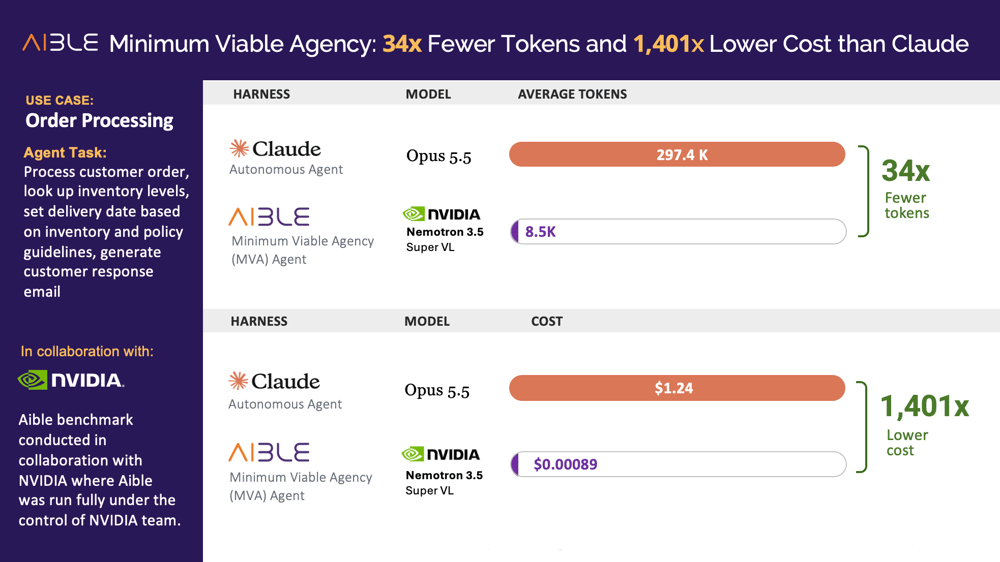
Here is a comparison of Aible for an analytics use case compared to multiple frontier models. If you wish to check these numbers yourself, please visit the Aible Challenge Benchmark page where you can see the detailed methodology, datasets used, and prompts so you can recreate these tests yourself. You can also participate in free benchmarking projects with your own use cases. See details at the end of this blog.
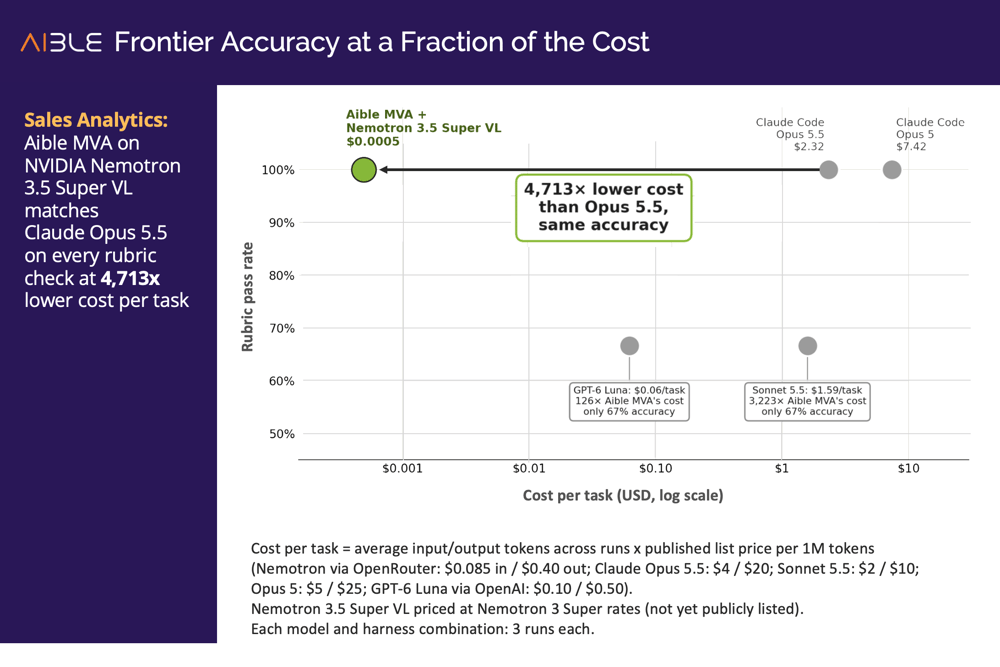
Why Aible chose Nemotron Super 3.5 VL for building MVA agents:
Aible uses our autonomous agent solution AibleClaw powered by Nemotron models for creative prototyping and testing; automatically observes the autonomous agent to detect underlying templatizable patterns; then saves off successful agents as templates for standardized, repeatable execution. Furthermore, the plan, tools, memory access, etc. in such templated agents are completely locked down so the templated agents can’t go rogue. Such templated agents are also usually significantly more token efficient than autonomous agents because they don’t have to spend tokens on the expensive planning steps, errors, backtracking, etc. Aible has actually built MVA agents for years and such agents have been proven at multiple Fortune 500s at scale.
The problem was that the MVA agents had to be built manually because frontier labs do not allow systems to observe the output of their models to auto-improve competing solutions. Things started changing with the Nemotron 3 Super model which was suitable for creating such autonomous agents from simple prompts.
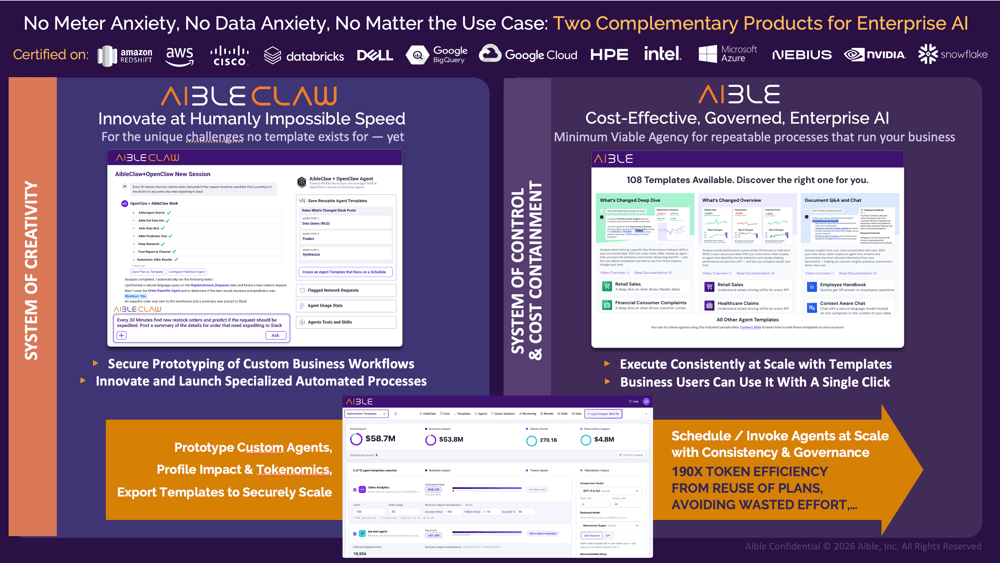
The permissive licensing for the Nemotron models allowed Aible to automatically observe autonomous agents powered by Nemotron 3 Super or Ultra models and then create MVA agents powered by the smaller Nemotron 3 Super or Nemotron 3.5 Lightning models. But with a prior Nemotron model, we were only hitting about 50% success with getting the autonomous agent to work on the first try. With some user feedback, the prior model did manage to build the autonomous agent successfully 100% of the time, but the 50% first-try success rate was a concern for adoption at scale. With Nemotron 3.5 Super VL, the autonomous agent creating process has a 80% first-try success rate for a complex claw creation process, and this is a big win. For the following test, we asked the systems to generate an agent that would:
- Process a customer order
- Check inventory for product availability for the items in the order
- Set a delivery date based on inventory availability and the guidelines in a policy document
- Generate customer response email including any special delivery instructions
This was of course a fairly complex autonomous agent and we compared Nemotron 3 Super and Nemotron 3.5 Super VL against Claude Code using the powerful Opus 5 model. For just the autonomous agent creation process, not the MVA creation process, the results were as follows:
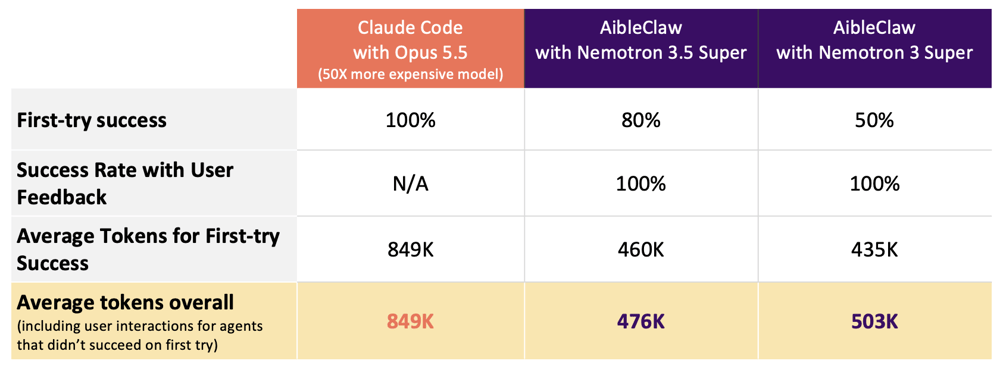
Thus, for the autonomous agent creation process, AibleClaw using Nemotron 3.5 Super VL is already approaching the first-try success of the 50 times more expensive Opus 5.5 model. Even when some user guidance is needed to complete the process, the average total token counts still don’t approach the token counts of Opus 5.5. The big benefit though comes from the templatization / MVA process, where the MVA agents derived from the Nemotron 3.5 Super VL autonomous agents were over 220X more token efficient than Claude Code with Opus 5.5.
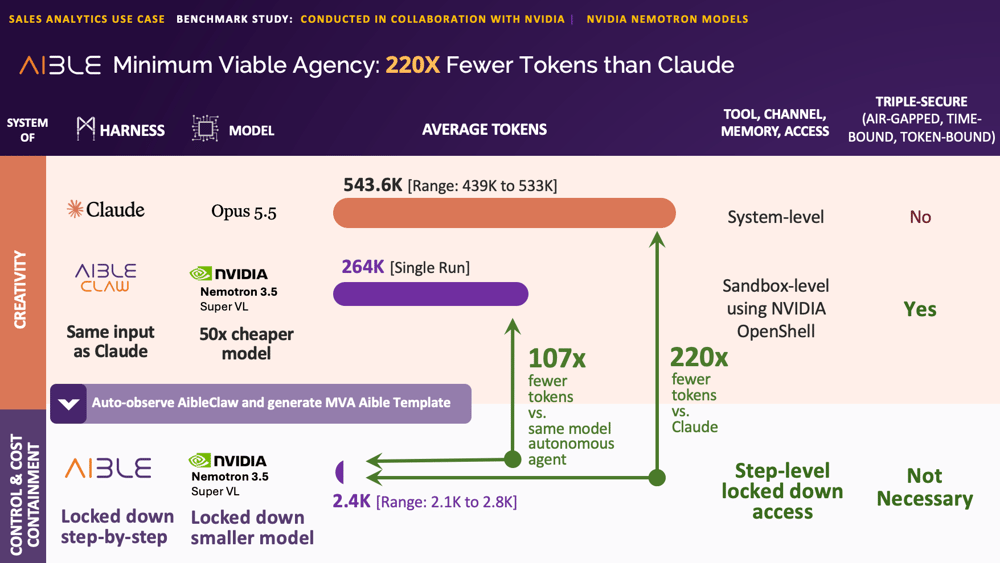
In this case the impact of the MVA templatization is visible in the comparison between the token count of AibleClaw using Nemotron 3.5 Super VL (264K tokens) and the Aible MVA Agent using the same model (2.4K tokens). Thus, the MVA agent is 220 times more efficient compared to Claude with Opus 5.5 and 107 times more token efficient compared to the corresponding AibleClaw autonomous agent.
Other NVIDIA technology leveraged by Aible to create MVA agents:
-
NVIDIA NemoClaw: AibleClaw leverages and significantly extends the NVIDIA NemoClaw open source project.
-
NVIDIA OpenShell: Aible uses NVIDIA OpenShell (part of the NVIDIA Open Agent Safety Platform) as a secure sandbox to run the autonomous AibleClaw agents. Such sandboxes are crucial to ensure the autonomous agent does not get direct access to credentials that would allow them to access enterprise resources in unauthorized ways.
-
NVIDIA desktop and deskside supercomputers: Some Aible customers want a complete guarantee that their autonomous agents can’t break out. To achieve that we can run AibleClaw with the NVIDIA Nemotron models completely air-gapped (disconnected from the internet) on devices like the NVIDIA DGX Spark, DGX Station, and the upcoming RTX Spark. MVA templates are exported from the device in the form of JSON files and run on the Aible platform designed for Control & Cost Containment. Only the locked down MVA agents ever get access to enterprise systems.
Moreover, the same 100X token efficiency increase for MVA agents enables Aible to run such agents faster end-to-end on these desktop supercomputers than the corresponding autonomous agents on the cloud. This addresses the performance concerns related to running models like Nemotron 3 Super (and soon Nemotron 3.5 Super VL) on the DGX Spark.
What is next for MVA agents
MVA agents open up various opportunities to optimize and secure enterprise AI further. Here are some of the domains we are actively collaborating with our partners on.
-
Leverage "System One" AI classification models to route to the correct MVA agent: One problem with MVA is that you end up with multiple specialized agents instead of one generalist agent. “System One” classification models like Jev and its open source equivalents are an excellent way to route an user request to the right MVA agent.
-
Optimized post-training: It is much harder to post-train autonomous agents because they can perform a wide variety of tasks. MVA agents are more tightly bound to specific tasks, thus it is easier to provide them task-specific feedback and thus post-train them more efficiently. Aible already demonstrated this with NVIDIA Nemotron 3.5 Lighting models where just $0.80 of training on only 400 rows of focused training data for a customer-specific text-to-sql use case achieved a 20% improvement over the base model accuracy.
-
Optimized KV-Cache: MVA agent templates give us a roadmap for what information will be used by agents in the later steps of the MVA template. This enables more efficient KV-Cache.
-
Optimized Mixture of Experts (MoE) Caching: MVA agents tend to leverage a smaller and consistent subset of the available experts because the MVA agents are so task-specific. This enables more efficient execution of MoE models on smaller hardware because only a subset of the experts needs to be in memory for efficient execution.
-
Improved Automated Agent Monitoring: Autonomous agents vary significantly in their behavior and the same task can easily require a very different number of tokens, require the activation of very different experts, or require access to different resources. This makes these agents very hard to automatically monitor as it is hard to define the baseline ‘normative’ behavior. Because MVA agents are locked down, tend to use a very consistent number of tokens across different runs, tend to leverage a relatively consistent set of experts, and access a small set of resources, any deviations of behavior are much easier to detect automatically.
-
Optimized Concurrency Settings: MVA agent templates give us exploitable information on the workload characteristics of the MVA agents and this information can be used to optimize the concurrency settings to deliver optimal cost-performance tradeoffs as previously highlighted by Aible where setting optimal concurrency enabled up to 30X better cost performance.
The Aible MVA solution is available today from partners like Dell, HPE, Cisco, TD Synnex and resellers. We are conducting a series of joint benchmarks across use cases demonstrating both the tokenomics benefits and accuracy improvements from MVA agents.
For example, an US Telco analyzed MVA agents within their lab environment using NVIDIA Nemotron models and Dell servers & 5G laptops with the Aible solution:
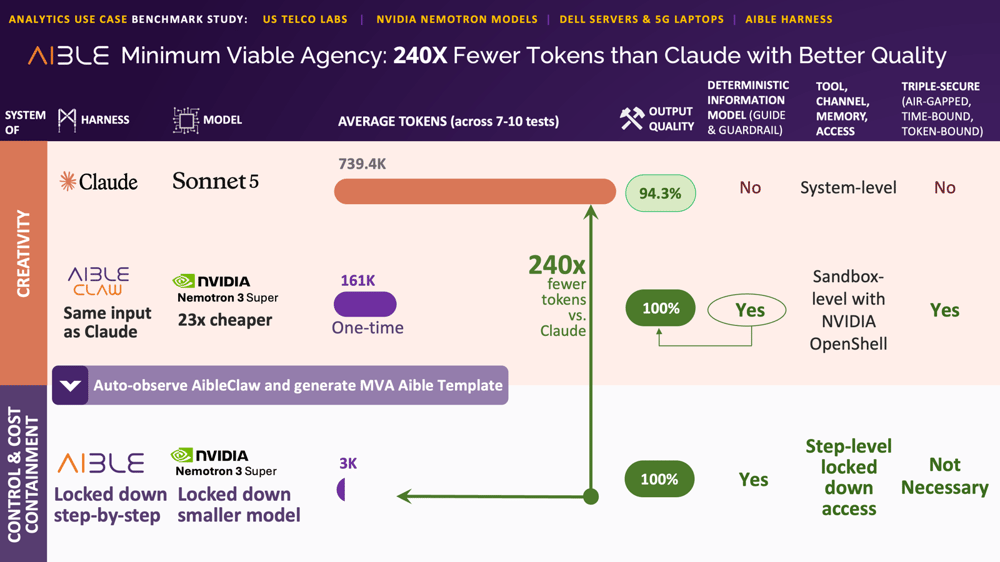
Please contact us here if you would like to participate in a similar benchmark for your unique use case.
Also please read these articles for additional information on MVA and how it can help address the security concerns facing the AI industry while reducing token costs by 1000X (conservative estimate based on 100X lower token counts paired with 50X cheaper model).
- Aible CEO’s post on MVA on LinkedIn
- Dell blog on Aible MVA and Dell Blueprint on the Dell Automation Platform
- HPE blog on Aible MVA and HPE Private Cloud for AI
- Cisco blog and video mentioning Aible MVA


